Tuesday, June 23, 2015

Delhi's Afghan affair


It does me good to take time off to explore the city I have come to love deeply. Delhi has in itself several key ingredients that I relate to - a glorious history, terrible macabre tales, a fetish for the undead. Delhi is as firecely female as one can imagine. Despite being vandalised, for beauty, for power, for position, she still stands mighty and evermore enchanting and mysterious. I chose a Sunday to explore the story of how Afghan's came to Delhi and made, for a short while, quite the mistress of her. The tale did not go very well as the leader of the walk was a terrible bore. History is not meant to be read out of pages and enacted on cues, it is meant to be shared with the very passion with which it was lived, no? There were some quite interesting bits and the ruins spoke volumes by themselves. I revisited the Purana Qila (Old Fort) later by myself and found it a better experience. Let's start with the entrance. Of the four entrances to the fort, only two remain functional today. This is the one adjacent to the Zoo.


The gate has the same structure and texture as that of most Mughal forts in India. A lot of the detailing being borrowed from the Rajput school of architecture, that is pointed edges attached throughout the facade of the gate to keep invaders out. The pointed edges have been lost to time but the facade reamins.


The first look at the imposing Qila-e-Kuhna masjid holds promise at the windows.


The mosque's front, facing the East, is an elaborate one. I couldn't capture the entire structure in one frame on either visit but the centre seemed appropriate to share.


The interiors are very beautifully carvd. Drawing inspiration from Buddhist (as my walk instructor had pointed out) as well as other major Indian symbols, the chamber is an awe-inspiring one.


The Buddhist architectural influence to highlight the chants have been cleverly incorporated to heighten the prayer calls at the mosque, four times a day.


Equally impressive is the shrine, in the direction of the Mecca (West), that forms the centre of the mosque.


The trainagular corners caught my eye with the lotus featured prominently at their centre, a very Indian motif.


A single mynah, hardly representing any sorrow at the point, perched itself on one of the windows of the structure.


Once I had my fill of the mosque, I headed to the Sher Mandal. A single shrine standing at the heart of a manicured lawn, makes for a great picture.


I caught a glimpse of time gone by and what the future holds in this single frame.

Wednesday, June 17, 2015

The remains of Lal Kot


My travels have taken a back seat since I suffered a heatstroke two weeks ago. I am awfully short of breath all the time but thankfully, well on the way to recovery. Unable to leave town just yet, I sneaked away with bunch of friends to explore Mehrauli Archaeological Park in the city. The area was refereed to as Lal Kot in that time and had started out as one of the primary settlements if Delhi as we know today.

The image here is of Quli Khan's tomb, next to the boathouse on the premises.


I have never been a great photographer which explains my great joy at finding a good frame, even if someone already has before. This frame is one of my favourites for the Qutb Minar.


A beautiful corridor along the Rajjo ki baoli also caught my attention, it reminded me of the time I had visited the original Meena Bazaar in Fatehpur Sikri.


The impressive stairwell, Rajjo ki baoli, makes for an incredible picture as well.

Memories of Mandawa


On my first journey to Mandawa, that I have chronicled in an earlier post, I didn't do justice to one amazing facet of the region, Castle Mandawa.


I'm no stranger to the traditional Rajasthani welcome and I don't mean the one you get at resorts trying to make a quick buck by distracting you with antics. No, Castle Mandawa does not have anyone waiting to welcome you with a song and dance routine, just a simple plate with vermilion put as a bindi to your head and you can walk yourself into the main courtyard.

Castle Manadwa is actually Mandawa Fort, the royal family of the region still live here. Only part of the property has been converted into a heritage resort with a luxurious cafe and poolside and really beautiful rooms. I had to take special permission to take a tour.


Like most other palace resorts, the Indian experience seems to be reserved for a non-Indian audience. Of the 80 rooms in all, including the Royal suites, Luxury Suites, Deluxe rooms and Standard rooms, most were occupied by international visitors.

The palace is built upon a vast expanse and a network of pathways lead from from area to another, it is quite like a city within the castle walls. I was ushered first to the poolside where I took a few moments to soak in the sun watching some children splashing about in the clear water. Then, I was led to a central courtyard to see how the rooms has been arranged for the guests.

The picture took me straight back to the Hazara Rama Temple in Hampi that I had visited, just that these images were far less painstakingly done. The entire Ramayana has been painted within this courtyard by the local Shekhawati artists. I stood there gaping at one image after another, soaking in the chapter in history until I was beckoned by my usher to have a look at the room. It was a deluxe room and quite cozy for a single seater.

I loved the ceiling of the bedroom which was painted completely in vibrant colours. The sitting area with a lovely window to spend hours reading was a delight as well. It felt a little too constricted, specially in the bedroom.
Back at the poolside, I asked for a glass of lemonade and was swiftly requested to join other visitors at the main cafe outside. Visitors are not served within the premises. Although the few moments within the Palace walls did make me feel no less than royalty, there were several polite reminders that I was not, I chuckled to myself savouring the sweet lime I ordered from the cafe.

Friday, June 5, 2015

The pen-toting fools!


I have quite frankly had enough of these newbies rising every other month with fresh "perspective" on destinations for the travel magazine whose content I manage. The fact is, there is no "perspective" and should I find a hint of it, it definitely is not "fresh". Sitting down to edit someone's story is nothing short of hacking off my arm. Unable, either to reach out to the writer to question their understanding, or to find any solace or help from office, it makes for a very stressful period. I have listed, for my benefit, as well as for all editors in the world, a few basic points that you must keep in mind while penning your travel experience.

Headline, intro, text - If you still need to be told that all stories require a headline and that a writer's suggestion for headline always takes the precedence over the editing teams, you shouldn't be writing. Kindly always follow the headline with a short (one to two line lead-in about what you destination is, where it is located and at least one standalone feature of it - for example: Bikaner in Rajasthan is a great destination to spot camels running along the sand by the train tracks. I stopped here a while to see what else the town holds in its fold). You can now start the text for the story.


Past, present, future - If your travel plans are made of dreams, kindly let them stay there. It is easy to lose track of time in a dream sequence, in reality editing tense after every sentence is a serious bummer. It requires a little effort from your end as most writers I know prefer to break their writing, thus increasing the chance of changing tense. Most writer go back and run through their articles, scrutinising them to avoid mistakes.


Fact check - There has been a new breed of writers who procrastinate writing till the last minute and then rush through the articles without checking facts. The temple you are writing about is 1,500 years old because the tour guide said so, really? Most protected monuments have boards carrying details of the monument, click a picture of them and keep them for reference while writing your story. A lot of Indian cities have undergone change in names, kindly mention your preferences if you have not included the updated names in your copy.


Poetic Licence - It's quite one thing to use poetic licence to expand and elaborate your emotions while writing a travelogue. It is quite another to use the same to hint at the facts. For example: The moon seemed so low that I could literally touch it - You cannot touch the moon from planet Earth, period.


Literal translations - English is not our primary language and no one will penalise you for a fault here and there but to use idioms and popular sayings from a local language and translate it word by word into English and apply it to your sentence is simply wrong. I have not balded my head and I will not have it hailed upon. Go figure!


I, me, myself - This one is probably a style bias but editing copies that have too many "I" in it feels strange. I went here, I did this, I saw this and then I thought that I did not like it. There are many ways to express your travel experiences, narrating everything from your perspective will surely get boring after 500 words.


The insufferable know-it-all - There are travellers and then there are these. Quite sure you have met the kind of travellers who keep telling you that your trip to a place was incomplete because you didn't go to that particular spot and face this particular direction! Yes, the know-it-all are always out to ruin every travellers joy of exploration by thrusting their own limited experience into everybody's faces. Reading their articles gives me depression and I cannot, for the love of life, understand why anyone would want to publish such nonsense.

Monday, June 1, 2015

A playground for the clouds


I have always been fascinated when the clouds come rolling in, covering the tops of the mountains, like a natural façade. A moment of private bliss for those living on the mountain tops. Born and raised in the plains, the mountains continue to overwhelm me. This particular morning, I woke up to a cool breezy morning with absolutely nothing in view from the window. A few soggy leaves apart, everything seemed covered by the mist. It took more than a moment for me to realise that I was in that part of the mountain top shaded by the clouds, as seen from below.
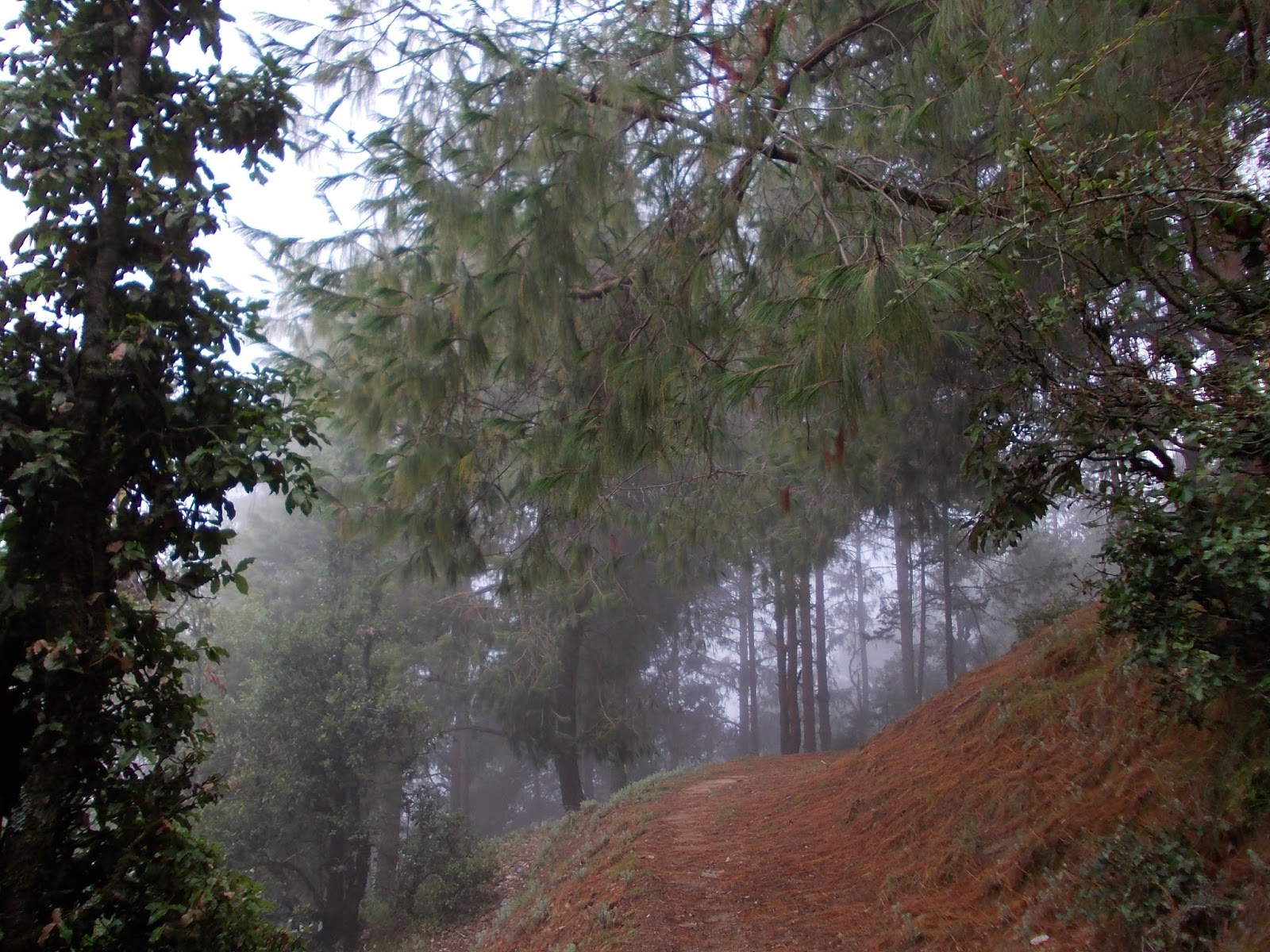
The monsoon brings with it an almost continuous onslaught of moisture-laden clouds. The only way of knowing you’ve been there is after the cloud has passed, leaving you drenched on the outside and strangely refreshed on the inside. It is not an experience one would like to simplify through words. This I realised while sitting mindlessly among the rotting pine leaves that did little to shelter me from the light drizzle that had begun but a lot to add a sense of drama to the moment.

Hiking in Dhanachuli

Getting to the stretch of pine forest was no trouble. However, getting back… that became quite another story. I was part of a group from the resort I was staying at to head out for the hike. I wouldn’t mind except that they turned out to be bitten majorly by the social media bug. Needless to say, with the numerous exclamations and variations of “Oh my god! It’s so beautiful” going on, the birds scattered quickly leaving nothing to sight.
The hiking trail seemed well treaded through the beginning. With a few of the members starting the walk with a pose for Facebook, I decided that I would keep up with the guide instead of lingering with the happy people. My plan was foiled very soon when I found out that the guide had to keep stopping for the rest of the group to catch up. No sooner than we had reached slightly denser part of the jungle, I fell behind. I decided to stop and let the group pass hoping that once their voices had faded a bit, as they advanced, I would still have hope for some sighting. The residents of the mountains are hardly fooled that easily. At least I was able to hear their songs from a distance.
Once into the depth of the trail, the drizzle began. I rushed along the now-partially visible trail to catch up with the group when I suddenly came upon a stretch of pine trees. The fallen leaves lending a magical golden-brown hue to the entire slope of the forest floor and it is here, that I was drenched leisurely by a cloud dragging past. My heart skipped a beat at the beauty around me and I sat by the path, trying to soak in every detail in that moment. No birds sang, no crickets either, there was just the sound of the passing clouds and my ragged breath.

Feathery friends

A dear friend of mine had written about the ravens when she wrote of Mukteshwar. An avid follower of Game of Thrones, I must admit it was a little spooky to be surrounded by the birds all the time. Of all the feathery residents of Kumaon, the raven is least perturbed by human presence, it seems. Unlike the friendly, smart crows of the city, raven have a very different caw. One particular raven and I seemed to get along quite well. I believe the staff of Te Aroha (the picturesque resort I was staying at) are quite friendly with the birds in the region. And so, on the very first afternoon of my stay there, I found myself being observed by a nosy raven on my window. After much stuttering and stumbling, he finally uttered a “caw”. Finding no response, he left. Only to return in a while and caw at me again.
I spent better part of my evening at the resort in their garden. A lovely swing provided for a perfect spot to wait and watch the bird returning to their nest in the trees in the resort and all the way across on another mountain as well. Apart from several finches and ravens, I found two noisy babblers among the scarlet minivets, blue-fronted redstart and a red-billed blue magpie. A raven visited each morning to greet me at the start of the day and spent some time in the evening with me before setting out to his nest somewhere in the mountains nearby.

Gods of the mountains

Faith can move mountains, I have heard. On my second, and thankfully quiet, hike through the forest, I came upon a shrine dedicated to Lord Shiva. In Dhanachuli, he is worshipped as Edheshwar. The closest village has been named after the Lord, Edhedhar. The tiny shrine has a paved entrance but no semblance of a temple. The idol stands at the base of two trees and is marked by the metallic trishuls that have been placed around it.
My guide told me that it is during the season of sawaan (monsoon) in the Hindu calendar that the most activity can be observed here as women and girls from near and far gather to pray to the Lord in hope for a good husband. Being hidden away in the folds of the mountains, it takes great courage for the women to gather here. The oak forest lends an element of somberness to the air. I sit there and my guide brings out two cups of tea. I sit observing the spider webs sagging with the weight of the raindrops. The mountains are known as the keeper of legends, every fold has a different story to tell. The renowned hunter and author, Jim Corbett, had once described Dhanachuli to be among his best-loved destinations in the Kumaon region.
It was during my visit to the Mukteshwar temple in the city that shed more light on some popular folktales of the region. The festival of Bagwal, I came to hear from a local priest at the temple is one such unique tale. On the day of Raksha Bandhan, women fast from morning and assemble at the temple to offer prayers and observe rituals for the Varaha Devi. It is said that as soon as the first plate of offering is provided to the Devi, she expresses her acceptance by making it rain. It is known to rain on every Raksha Bandhan. It is a custom worth witnessing when you are in the area. The Mukteshwar temple, the priest tells me, is one of the dham (sacred space) for worshippers of Shiva. As I sat, listening to his stories interspersed with the falling rain that I had braved for a view of the Lord, I marvelled at how hallowed the path of a traveller is, for we happen to stumble upon such sacred spaces and collect such blessings, that we had not planned. A play of divine love for the believer.


Te Aroha
One of the best accommodations available in Dhanachuli, not only does the resort make for a classy sojourn but also comes armed with a keen sense of preserving the ecological balance in the region. The number of rooms has been limited (10 rooms) to cut the impact of humans on the mountain. Low lighting on the premises ensures that the birds nesting in the neighbouring trees are not disturbed. A labour of love, the property was initially a summer home for the Batra family. Over time, they have developed it into the wondrous lodging that stands today.
The undisturbed view of the Himalayas from the property has drawn the lovers of the mountains to its fold for years. The simple yet elegant way of life of the mountains is reflected in every aspect of the resort. Sumant Batra, the owner of the property, is quite the connoisseur of the fine details that make life. The team at the hotel, mainly locals, are efficient and driven to make every visitors stay memorable.
There are no television sets in the rooms, giving the visitors an excuse to look out of the large windows and soak in as much of the mountain range or the mist as possible. There are no air-conditioners or fans in the rooms either. The most outspoken facet of the rooms is the stately four-poster bed. Should one be more inclined to observe more human pursuits, the Chitrashala – a museum dedicated to Graphic art – put together painfully over the years by Sumant Batra is an absolute delight. There is a library as well as lovely reading room for spending some quality time.

The resort will be the seat of the first Kumaon Literary Festival from October 23-27. Be there!

Thursday, May 28, 2015

Jai ho! Indian railways!


I don't generally have family visiting me and since last year, I prefer to travel by air - even if it stirs the inexplicable binge. Yes, I am nervous about flying, I guess I will always be but it is time-efficient. So, when my maternal uncle and aunt came to visit me, I was excited to pick them from the railway station. I remember feelign excited about returning to the railway station after so many months, little did I know what lay in store for me that very evening.

The Gujjar uprising has led to delay and rescheduling of several trains and Indian railways, at its competent best, thinks it only wise to have travellers wait at the platform, in the heat wave that is causing roads to warp. So, the Mumbai bound Rajdhani was scheduled to depart from New Delhi railway station at 4.25 pm. We arrived well in time and were at the platform by 4 pm, only to realise that the train had been rescheduled for 6 pm. The gruelling two hour wait in the summer heat gave me ample opportunities to see children and elders getting sick and throwing up on the tracks. Few local trains came and went, we waited, gulping water whenever we could, unable to leave the platform with the luggage we bore, unable to find a single decent spot to sit under the inefficient ceiling fans. Perhaps, I should not blame the fans, the phone showed a temperature steady at 45 degrees.

When it was finally 6 pm, horrified expressions went about as GT Express pulled into the platform number 3. Most of the travellers bound to Mumbai via the Rajdhani were sick already and very visibly irritated as the announcer said that the Rajdhani faced certain technical issues and would be brought to the platform after the GT Express departed. This last hour is when pandemonium ensued. Tempers flared and frequent sickness led to a general stench of vomit and sweat on the platform. The Rajdhani finally pulled in at 7 pm. Travellers had no way to know when they would reach Mumbai but it didn't seem to matter as everyone clambered onto the AC coaches for whatever respite they could find.

Most of the women had been consuming a lot of water, owing to the heat, but were not able to use the toilets and there was quite the rush to occupy the washrooms even before the train left the station. The train finally left at 7.25 pm. Leaving my uncle and aunt to find their way to Mumbai with whatever food Rajdhani would provide, an extra bottle of water and some fruits, I mustered whatever strength I had left to head back home in the city. I got sick on the journey back.

My uncle and aunt, meanwhile, called the next day to share that the train would take 26 hours to get them to Mumbai. They thanked me for the fruits I had left with them, there was little else to have. The constant question that arose was why Indian railways cannot make a simple app to notify travellers of trains running late or were rescheduled? Why did travellers for several trains have to wait in the gruelling heat only to be told that the train had been cancelled? My uncle and aunt reached Mumbai at 11 pm last night, 28 hours after departure from New Delhi. Needless to say, they will not be taking a Rajdhani for a very long time.

Wednesday, May 20, 2015

How I found Krishna and left him right there!


It all started with a friend's visit to Vrindavan to pray for happiness for her family. Guided by a family priest, she visited a particular temple in Vrindavan with family but did not feel as much at peace she had hoped to be. In our little chat, late one night after she was back, I talked about my own experiences in 'brajbhoomi'. We decided right there that we would head out for a little girl's away from town trip. On the said Sunday, we started from Delhi in our own vehicle. None of the boys with us, we poured our hearts out for better part of the way.
My plan was to take her to Gokul, the village where Krishna's father had delivered him to Yashoda. We found ourselves off the National Highway 2 and on the rather bumpy ride to Nandgaon. The road was not easy and there was no respite, given the summer sun at its peak and the poor condition of the roads. Once we reached the main temple in Nandgaon (Incidentally, this is the village of Krishna's foster father. His wife, Yashoda, was in Gokul, her maternal village, to deliver her child) we were received with curious eyes that soon turned unkind, as soon as they heard that we were unaccompanied by "our husbands". Two grown women visiting this part of the country alone, is not well-received. On of the elders commented from the porch how "we were looking for trouble". Guarding my friend, I walked the stairs to the temple where we were received by a number of men dressed in white clothes. They kept asking where we were from and then whispered among themselves as we stood in the temple to pray. Needless to say, we decided to leave quickly. There was a beautiful view to be enjoyed, as the temple is constructed at a height and offer an undisturbed view of quite a distance but we did not want to attract any more attention. A bunch of well-dressed children huddled around us, begging for cold drinks and goodies and we managed to make our way back to the car and left quickly. Neither my friend nor I spoke of the episode at the time.
It was quiet and rushed drive back to the national highway. I quickly made my mind to head to Gokul village now and hoped the temple would still be open for visitors. Most temples in Vrindavan and its surroundings are closed in the afternoon as Krishna is worshipped as a living God. The deity, worshipped as the idol, is woken in the morning, served food, sung songs to and even allowed an afternoon nap! The temples remain closed while the deity takes his siesta.
The village of Gokul lies just ahead of Mathura (17 kms or so). Having been a part of the grand celebration of "Uttar Pradesh development" and having seen the massive hoardings and boards along the journey, I was sure I would be there in time. Wrong! Turns out that there are hardly any signs to Gokul. I even spotted two large road signs torn down along the National Highway 2. It was starting to get uncomfortable. We kept stopping to as for directions, and the probing eyes of the locals was unmistakable. Then, a few kms before Mathura, the locals started saying, "I can take you there for Rs 50." No one wanted to give us any directions! I do not need to state that two women in a car are not the best setting to invite a stranger into. I seen enough horror films to know what follows. We kept driving along the National Highway. Finally, at one major turn we were stopped by a bunch of men, asking for Rs 50 to guide us to the temple. When we refused, politely and asked for directions. They pointed towards a main road on the left and said it was straight ahead. We thanked them to realise shortly afterwards that we were headed straight into the main city of Mathura. After a painful hour of driving through the traffic and stopping to ask for directions at every turn and crossing, we decided to give up ad head for whichever Highway we could find.
Another half hour of driving back and forth on the same roads and criss-crossing several major traffic centres, we seemed to finally come upon the correct path and found ourselves under a single (and only signboard) pointing to Gokul. We could have been relieved but the worst was far from over. As soon as we set foot out of the car (and into the blazing sun) we were surrounded by men of all ages trying to be our guide for Rs 100. I had to shout at them to get away and then started to head towards the only logical road leading into the village and away from the car parking. We picked up sweets for the deity, more to appease the sweetseller to point the right direction than to please any God. But it was going to take some more effort for the Gods to be pleased! From comments on being unaccompanied by men, hence looking for trouble, to being threatened that we would lose our way in the alleys. When we did finally found our way to the ghat and then to the house, we were very relieved.
At the house, now converted into a temple to worship Krishna as a child, the priest sat facing his back to the Gods. A strange sight indeed! He spoke continuously with every sentence he uttered having at least two references to money. He kept pointing to a box set aside for offerings of cash to "feed brahmins". And hardly bothered with any semblance of devotion. I agreed to pay him Rs 100 if he would let me sit in peace and pray, he did not. I got up to leave and he yelled at me for the money. I refused and he threatened to curse me. I yelled back but honestly, I felt so disgusted by the whole episode I flung the money and a fifty extra at him.
I did find the deity I went looking there for but I had to pay the price with my own faith on humanity. Such a tragedy!