Thursday, May 28, 2015

Jai ho! Indian railways!


I don't generally have family visiting me and since last year, I prefer to travel by air - even if it stirs the inexplicable binge. Yes, I am nervous about flying, I guess I will always be but it is time-efficient. So, when my maternal uncle and aunt came to visit me, I was excited to pick them from the railway station. I remember feelign excited about returning to the railway station after so many months, little did I know what lay in store for me that very evening.

The Gujjar uprising has led to delay and rescheduling of several trains and Indian railways, at its competent best, thinks it only wise to have travellers wait at the platform, in the heat wave that is causing roads to warp. So, the Mumbai bound Rajdhani was scheduled to depart from New Delhi railway station at 4.25 pm. We arrived well in time and were at the platform by 4 pm, only to realise that the train had been rescheduled for 6 pm. The gruelling two hour wait in the summer heat gave me ample opportunities to see children and elders getting sick and throwing up on the tracks. Few local trains came and went, we waited, gulping water whenever we could, unable to leave the platform with the luggage we bore, unable to find a single decent spot to sit under the inefficient ceiling fans. Perhaps, I should not blame the fans, the phone showed a temperature steady at 45 degrees.

When it was finally 6 pm, horrified expressions went about as GT Express pulled into the platform number 3. Most of the travellers bound to Mumbai via the Rajdhani were sick already and very visibly irritated as the announcer said that the Rajdhani faced certain technical issues and would be brought to the platform after the GT Express departed. This last hour is when pandemonium ensued. Tempers flared and frequent sickness led to a general stench of vomit and sweat on the platform. The Rajdhani finally pulled in at 7 pm. Travellers had no way to know when they would reach Mumbai but it didn't seem to matter as everyone clambered onto the AC coaches for whatever respite they could find.

Most of the women had been consuming a lot of water, owing to the heat, but were not able to use the toilets and there was quite the rush to occupy the washrooms even before the train left the station. The train finally left at 7.25 pm. Leaving my uncle and aunt to find their way to Mumbai with whatever food Rajdhani would provide, an extra bottle of water and some fruits, I mustered whatever strength I had left to head back home in the city. I got sick on the journey back.

My uncle and aunt, meanwhile, called the next day to share that the train would take 26 hours to get them to Mumbai. They thanked me for the fruits I had left with them, there was little else to have. The constant question that arose was why Indian railways cannot make a simple app to notify travellers of trains running late or were rescheduled? Why did travellers for several trains have to wait in the gruelling heat only to be told that the train had been cancelled? My uncle and aunt reached Mumbai at 11 pm last night, 28 hours after departure from New Delhi. Needless to say, they will not be taking a Rajdhani for a very long time.

Wednesday, May 20, 2015

How I found Krishna and left him right there!


It all started with a friend's visit to Vrindavan to pray for happiness for her family. Guided by a family priest, she visited a particular temple in Vrindavan with family but did not feel as much at peace she had hoped to be. In our little chat, late one night after she was back, I talked about my own experiences in 'brajbhoomi'. We decided right there that we would head out for a little girl's away from town trip. On the said Sunday, we started from Delhi in our own vehicle. None of the boys with us, we poured our hearts out for better part of the way.
My plan was to take her to Gokul, the village where Krishna's father had delivered him to Yashoda. We found ourselves off the National Highway 2 and on the rather bumpy ride to Nandgaon. The road was not easy and there was no respite, given the summer sun at its peak and the poor condition of the roads. Once we reached the main temple in Nandgaon (Incidentally, this is the village of Krishna's foster father. His wife, Yashoda, was in Gokul, her maternal village, to deliver her child) we were received with curious eyes that soon turned unkind, as soon as they heard that we were unaccompanied by "our husbands". Two grown women visiting this part of the country alone, is not well-received. On of the elders commented from the porch how "we were looking for trouble". Guarding my friend, I walked the stairs to the temple where we were received by a number of men dressed in white clothes. They kept asking where we were from and then whispered among themselves as we stood in the temple to pray. Needless to say, we decided to leave quickly. There was a beautiful view to be enjoyed, as the temple is constructed at a height and offer an undisturbed view of quite a distance but we did not want to attract any more attention. A bunch of well-dressed children huddled around us, begging for cold drinks and goodies and we managed to make our way back to the car and left quickly. Neither my friend nor I spoke of the episode at the time.
It was quiet and rushed drive back to the national highway. I quickly made my mind to head to Gokul village now and hoped the temple would still be open for visitors. Most temples in Vrindavan and its surroundings are closed in the afternoon as Krishna is worshipped as a living God. The deity, worshipped as the idol, is woken in the morning, served food, sung songs to and even allowed an afternoon nap! The temples remain closed while the deity takes his siesta.
The village of Gokul lies just ahead of Mathura (17 kms or so). Having been a part of the grand celebration of "Uttar Pradesh development" and having seen the massive hoardings and boards along the journey, I was sure I would be there in time. Wrong! Turns out that there are hardly any signs to Gokul. I even spotted two large road signs torn down along the National Highway 2. It was starting to get uncomfortable. We kept stopping to as for directions, and the probing eyes of the locals was unmistakable. Then, a few kms before Mathura, the locals started saying, "I can take you there for Rs 50." No one wanted to give us any directions! I do not need to state that two women in a car are not the best setting to invite a stranger into. I seen enough horror films to know what follows. We kept driving along the National Highway. Finally, at one major turn we were stopped by a bunch of men, asking for Rs 50 to guide us to the temple. When we refused, politely and asked for directions. They pointed towards a main road on the left and said it was straight ahead. We thanked them to realise shortly afterwards that we were headed straight into the main city of Mathura. After a painful hour of driving through the traffic and stopping to ask for directions at every turn and crossing, we decided to give up ad head for whichever Highway we could find.
Another half hour of driving back and forth on the same roads and criss-crossing several major traffic centres, we seemed to finally come upon the correct path and found ourselves under a single (and only signboard) pointing to Gokul. We could have been relieved but the worst was far from over. As soon as we set foot out of the car (and into the blazing sun) we were surrounded by men of all ages trying to be our guide for Rs 100. I had to shout at them to get away and then started to head towards the only logical road leading into the village and away from the car parking. We picked up sweets for the deity, more to appease the sweetseller to point the right direction than to please any God. But it was going to take some more effort for the Gods to be pleased! From comments on being unaccompanied by men, hence looking for trouble, to being threatened that we would lose our way in the alleys. When we did finally found our way to the ghat and then to the house, we were very relieved.
At the house, now converted into a temple to worship Krishna as a child, the priest sat facing his back to the Gods. A strange sight indeed! He spoke continuously with every sentence he uttered having at least two references to money. He kept pointing to a box set aside for offerings of cash to "feed brahmins". And hardly bothered with any semblance of devotion. I agreed to pay him Rs 100 if he would let me sit in peace and pray, he did not. I got up to leave and he yelled at me for the money. I refused and he threatened to curse me. I yelled back but honestly, I felt so disgusted by the whole episode I flung the money and a fifty extra at him.
I did find the deity I went looking there for but I had to pay the price with my own faith on humanity. Such a tragedy!

Wednesday, May 13, 2015

Morning at Mondarmoni


It was about six in the morning when I quietly crept out of the resort by the Bay of Bengal. I had been by the sea for an entire evening but I hadn't got the chance to spend some quality time, alone. Knowing fully well that once my family wakes up, there would be no more chance to do so, I dressed quickly and quietly and rushed to the main gate. Only nto find it locked. The resort owners had had a long night and no one was awake yet to open the gates. No one in the resort was awake as yet. There was still about half an hour till sunrise, something I was not going to miss, not again. I looked around for a way to exit the resort and found that the wall on one side was low enough to jump over. Now, it has been quite a while since I attempted anything remotely as adventuruous. My brain was quick to suggest looking for an alternative but my heart, as always, yearned for trouble. I have to admit, as soon as I landed, safely, on the other side of the wall... I was ecstatic. Years of not taking risks, were regrettable. It was just a few more moments to the glorious sunrise, definitely not the best time for regrets, so I headed to the sea.


There was no one in sight and as is the nature of the sea, the water had withdrawn a long way from the beach. The beach was alive, though. Thousand of little red crabs scampered at the sensation of my approaching footsteps. I was obviouslly not welcome here. The red crabs, now a protected species, nest all day in the sandy beach of Mondarmoni and are active at night when humans, and other predators, are no threat to them. A good half an hour of carefully avoiding stepping on any nests or crabs, I was where the sea meets the sand. The beach, now extended as far as the eye could sea, was a glorious sight. Golden sands in the morning sun and the sound of the distant waves put me in a trance and my feet too heed of my heart's command and I walked on... seeking the sea. I stopped several times, spotting starfish, sea urchins and an incredible array of seashells. I walked on and on for about an hour, yet the promised horizon eluded me. With every step, I felt a nothingness engulf me. I seem to drop my worldly cares behind me and moved on to a promised happiness.


With every step the waves sounded closer, the sky seemed clearer and the horizon, unbroken. I walked on, feeling no fatigue, thirst or any human need. Finally, I came upon a slight mound of wet sand and beyond it, the sea. I had no notion of when the tide would turn against me and although logic appealed that I might be too far to return to safety in time, it did not seem important. The sound of the waves, crashing at my foot like clockwork, was magical. It was a powerful magic that held me there, where no man or woman ever stood. That place, that time, was mine. Only mine. I sank to my feet at the wonder of the creator, the blessings that led me to experience this powerful moment. As my mind whirled with the magnitude of the experience, the sea kept lapping at my feet in rhythm. Life goes on, I had heard so many times and here I was, moments after a spiritual experience, waking up to the reality of the saying. My life had changed in those few moments by the sea and yet, nothing changed for the sea.


It was time to return to my responsibilities. I turned around to the shore only to spot my husband in the distance, making his way towards me. The few people on the shore seemed like small specks, like the crabs from ealrier that morning. I xmiled and started to make my way back.

Monday, April 27, 2015

A modern sufi diary


Ajmer Sharif in Rajasthan has long been a prominent seat of Sufism in the country and, like any other centre of spiritual practice, it helps rejuvenate one’s mind and soul. Susmita Mukherjee visits the holy place to get a hands-on experience of the same...


I could begin by explaining how I ended up in the middle of the hinterland of Rajasthan with a share of hospitality that is the trademark of these quarters… but that would be another story. For now, I’ll keep the joys of the mighty Aravallis that tower before me as I soak in the flavour of the land, with a generous helping of gatta curry and hot chapatis, in the courtyard of a quaint cottage and take you on a journey through faith.

First impression

The reason I chose to stay here was because of the peace I felt at heart,” said Roza as we sat sipping a cup of hot tea at the Anjuman Guest House. I couldn’t help laughing at the irony of residing at a guest house on the beggar-infested street that led to the entrance of the Dargah Sharif. What peace could one possibly find here? But Roza, a tourist from Dimona in Israel, offered to take me around the dargah as she had come to see it over the past month.

After walking through the remaining expanse of the wide street with flowers and souvenir shops flanking both sides and alms-seekers stopping me at every step, we finally reached the Nizam Gate — the main entrance to the shrine. “When you climb these steps, you leave every worldly possession and clamour behind. You must have nothing but a sound faith,” said Roza. “The only identity of a true follower is his faith in the divine.” Her words calmed me instantly, the sight and sounds of the bustling market didn’t seem to bother me anymore as I handed over my footwear and proceeded to climb the steps. At the top, I felt like stepping into a different world, familiar, welcoming and yet so simple in its regularity that we crave for its solace in a mad, hectic world.

I walked through the gates and towards the talaab where I stopped to wash my hands and feet. “Everything around here reminds me of home,” she said. “The marketplace in my hometown was not very different and I often used to go to a dargah in the outskirts with my mother. I grew up seeing every beautiful part of my life falling to bits. Seeing life go on so normally here was startling at first but now I realise that this is how it was meant to be. The world was created for human beings like you and me to explore and appreciate the God’s great work.”

We walked across the market, selling flowers and chadars (drape for the saint) to be offered at the dargah. There was no haggling over prices. I merely took out the amount I was willing to pay and handed it to the shopkeeper who asked me if I wanted a chadar as well. He prepared my tokri (basket) as I watched Roza look longingly at the dargah. She had nothing to offer today except prayers.

I could see the pilgrims in a different light now. It was easy to distinguish those who had come to ask their benevolent benefactor for a favour from those who had returned to thank him for his kindness. There were also quite a few travellers, mainly foreigners, who wanted to feel the magic of Sufism, the egoless surrender to the divine as propagated by Moinuddin Chisti.


The way in

My tokri was ready. It was, unfortunately, too large for me to carry in my hand and seeing the crowd waiting to heave in, I understood the devotees’ habit of placing it on the head while entering the shrine. I walked towards the entrance, silently praying for Roza’s safe return, for finding peace within myself and in the world I live in. I lost sight of her in the crowd. I realised that our meeting was over and that I had to go forth on my own, find my path.

I jostled for space and was met with a mob trying to break in and out of the shrine. Fortunately, like every other pilgrim there who refused to give up, I found my way inside and offered prayers. When I emerged, I was overcome by a draining fatigue. I cannot say whether it was for the lack of space inside the shrine or the weight of the many little burdens that I had just shed. I found myself a quiet spot near a jaali (trellis) through which a group of women were looking at Chisti’s tomb. I sat down and meditated with them. After some time, I felt great peace and the crowd around me did not bother me anymore.


Khwaja’s legacy

Khwaja Gharib Nawaz, as the saint is fondly referred to by his disciples, holds an important place in the Sufi circuit of the subcontinent. He is hailed as the founder of the Chisti order of Sufis, said to be the descendants of Prophet Mohammed.

Moinuddin Chisti, as he was named by his parents, was born in Iran. After his father’s death, when he was just a teenager, he chanced upon a mystic walking by his garden. It was with his blessings that he embarked on his own journey of soul-searching. His quest took him to faraway lands and he met several scholars of his age. He finally came to India after a brief stopover at Lahore. He set up his base in Ajmer, continued his teachings and offered peace, guidance and solace to anyone who came to his door.

His shrine is at its colourful best during the festival of Urs, which marks the day when the Khwaja left his mortal body to be united with the divine after living the last six days of his life in isolation. Death is not considered inopportune in Sufism. It is, in fact, celebrated as the union of the soul with the source. Every year, those going for Haj are expected to visit the shrine at the time of Urs, which is scheduled according to the lunar calendar.


Return to reality

Having received the Khwaja’s blessings, I headed for the exit. Brushing my way through the crowd while looking for one of the khadims — men who have been serving at the dargah for generations and are always dressed in white with a black cap to cover their heads — I would have been lost for certain when a friendly pat on my shoulder made me turn around. Dressed in the traditional green attire with a string of white beads around his neck and a potli (pouch) under his arm, a fakir held out his arm as if beckoning me to follow his lead. He guided me through the crowd and brought me to one of the exits.

“Would you like to contribute to the deg (vessel) here? The light of the Sahan-e-Chiragh will always guide your way,” the fakir said, pointing to the courtyard lamp that I had missed during so many visits. I was aware that on festivals, the food and money donated by the pilgrims into the badi and chhoti degs (said to have been donated by Mughal emperors Akbar and his son Jahangir) were used to prepare a great meal for the public. I didn’t realise that it was one of the little joys that the people looked forward to. The smiling fakir looked on as I walked up to the edge of the badi deg and looked with new-found admiration at the amount of foodgrain, money and dried fruits that had been collected for a free kitchen.

After making an offering, I headed back to the fakir who then guided me to the lamp he had pointed at earlier. As I bowed my head in gratitude for the simple yet enlightening tour of the dargah, the fakir placed his hand on my head, blessed me and left.

My good deeds of the day done, I was content to head back to the materialistic city life.


Getting there

By air The nearest airport is at Jaipur, 135 km. The closest international airport is the Indira Gandhi International Airport at New Delhi, 350 km.

By rail There are several direct trains plying via Ajmer. Ajmer Junction is well-connected to the major cities of the country.

By road Ajmer is connected to New Delhi by the National Highway 8 via Jaipur and makes for a comfortable five-and-a-half-hour drive. The Rajasthan Roadways offers several luxurious and standard coaches for travel within and outside the State.


Copyright: Exotica, the wellness and lifestyle magazine from The Pioneer Group, available in all rooms of select five-star hotel chains across the country

Thursday, April 2, 2015

Fresh look at rotting paint

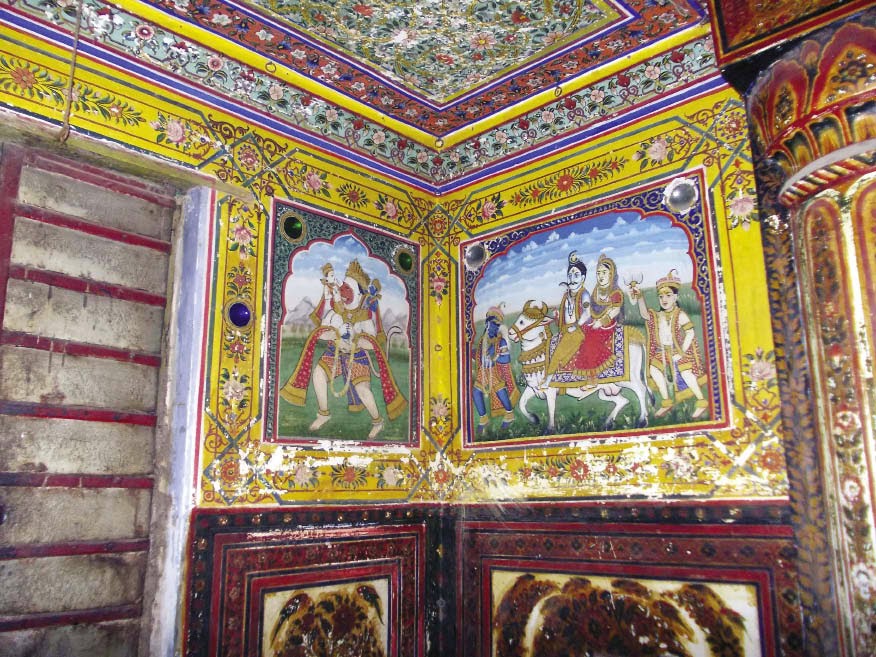
The image I had in mind were very different from what I stood before. The magical, painted expanse of the Shekhawati region in Rajasthan was nothing of the sort I could have imagined anyway. Here's the story I filed for Terrascape magazine on Mandawa.


The painted legends of the Shekhawati region were the reason for my most recent visit to Rajasthan. Having set out of New Delhi late in the night, the contrast between the mind-numbing oncoming post-office traffic through Gurgaon and the quiet, moonlit expanse that lay ahead of me beyond Pataudi was enough of a shock to my mind. The farther we progressed from the cold, material world, the more relaxed I felt and soon, I found myself happily pondering over the beautiful finds that lay hidden in the town that was still so far away. It was much after midnight that I arrived at the door of the Sara Vilas, my gracious hosts. Much of the resort was plunged in darkness, given the hour but the moon, now standing high in the sky, shed a hue of white on the green lawns and the plants as I made my way to the room accorded for me.


First impressions

Early next morning, I helped myself to a sumptuous breakfast from the lovely kitchen at the hotel. The car was waiting for me outside. I set out on a day of discovery. The first stop was the chowk in front of Saner Ram Ladiya. I almost immediately recognised it from the sets of the recently watched film, PK. The car came to halt right there and the driver left me to chatter away excitedly about the film. With bated breath I entered the Ram Ladiya. Painted all the way from the outside to the inside, each wall is a picture worth a million exclamations. I stared at length at each wall, wondering at the intricate detailing on each inch of the wall and how much of time and effort must have gone into the creation of such a marvel.

I had just exited the Ladiya and wondered if it would be a good idea to just loiter about and go wherever the road took me. I found a comfortable spot by a cold drink vendor a little ahead of the haveli. That’s where I met Ganesh Joshi, a local guide. While it was never his idea of a profession, he didn’t mind the extra income he could make by taking people around his home town. It was a great way to gather news of the town on an everyday basis. Turned out, he was modest. Not only was he charging me a meagre amount compared to what the regular guides charge – and they charge quite a lot – he was very well-known in his town. I was now in luck. He led me to the first of the painted havelis in Mandawa, Mohan Lal Saraf. The haveli looked every bit of its ancient self. Built almost 150 years ago and painted with images of Rajput culture and Krishna Leela, the haveli is a masterpiece. I immediately recognised a large painting of the king riding on an elephant. The elephant was decorated with tiny white flower motifs all over. It is one of the best known paintings of the region. Joshi informed me that it was this painting that inspired many replicas through the town. Leaving the Mohan Lal Saraf, I meandered through the dusty lanes, peering at every wall in the hope that a new surprise awaited me around the bend – and they did.

Touch of gold

When we finally got to Jhunjhunuwala Haveli, it could be easily seen that in those olden days the region had been quite abuzz with every household of any worth trying to outdo each other with its ornate painted walls. Although some of the havelis are now locked from the eyes of the inquisitive tourist, the decorated walls do not always hide the glorious history within them. From the balconies, chajjas, of the few havelis I had access to, I could find myself looking at an endless lane of homes with painted walls. Some curtained by a line of freshly washed clothes, some broken carefully to make space for an air-conditioner. From the outside, the Jhunjhunwala Haveli seemed like any other house of the region. A small inset in the large metal door acts as the entrance to the high walled house.


I find myself facing an elderly man, probably a housekeeper, coughing in the pale winter sun. He was sitting on a charpoy trying to say something urgent to the lady sitting by the door, peeling peas from their pods. The man looks at Joshi and smiles. I am presented to the man as a traveller from the big city. After a few questions, I inquire of the whereabouts of the owners of the haveli and am quite embarrassed to find out that the old man, still coughing on his charpoy, is the third generation to inherit the property. “My great grandfather was a very wealthy man and his riches were not restricted to money but also to children. He had many children and once the family business fell apart, the siblings started taking out whatever they could as their inheritance,” he says. “My grandfather and his son, my father, held on to the house while everyone else moved to the big city and built bigger mansions for themselves. My great grandfather was awarded a great amount of gold in his heydays. He used it as gold foil which he added on the walls of his sitting room. Today, our house is a great attraction for visitors because of my great grandfather’s whim.” I walked into the room as the new daughter-in-law led the way. “What we would have done without this room, I wonder,” she said. “We manage to get a decent sum from tourists who come to see it. My husband has a shop in the local market but it is not enough for our family.” The gilded room crafted by their great grandfather’s whim is a medium of income today.

Dust and shadows

My next stop was at the traditional four-walled stepwell. Apart from the painted mansions, it is these few standing stepwells that are a reminder of the town’s glorious past. “There are changing platforms on three of the corners for the men to change into fresh clothes or sit and talk. The women have an closed room in the last corner for changing. A small pool was marked for the children to bathe while the stepwell in itself was meant for pulling up water for the households,” informed Joshi. Though the stepwell is no longer in use today, it stands as a reminder of order that once prevailed here.

As I made my way to Castle Mandawa, where the royal family still resides in one section while the rest has been converted into a heritage hotel, I took in the feel of the place. Once lined with painted mansions and chattering families, Mandawa takes on a desolate look today. Far removed from the manicured experience at the hotel, Sara Vilas, the town was littered with filth along the alleys which were a turn off. The people live with pride of a bygone era, turning a blind eye to the need for the upkeep of the heritage around them. It is common to see neighbours, once relatives, squabbling over the number of tourists at their door. Joshi points out that not many Indians visit these areas; most of the visitors comprise students of art from international universities.


After a few moments of silence by the pool at the Castle Mandawa, I feel the urge to see the untold stories of the region. I am suddenly overcome with remorse at the loss of such a huge part of the cultural history as many of the walls lay unkempt. The paint was flaking off, leaving behind a trail of hideous forms and faces while the residents carried on, having taken their heritage for granted. There is pride in the history of the region, unfortunately, the people cannot afford the care of the private mansions anymore. I make my way back to the first haveli I had started my day with, drained completely of wide-eyed excitement. I rested under a tree and wondered how much of Mandawa would be left, if I returned.

Saturday, March 28, 2015

At the foot of the Shivalik range


As the car pulls into the camp, a flurry of black and brown activity catches my attention. We are a long way from the main road and quite deep into the forest. To my great respite, two of the camp’s faithful aides arrive just in time to greet us. Meeting Leo and Kaalu, two of the four dogs at the camp, ensures that my cramped muscles have enough to stretch about as they sniff out at my clothes and bags. Satisfied, they lead me to the dining area where the owner of the camp, Sunil Gupta, awaits. The journey has been a short six-hour drive but the last one hour has taken its toll. “The Shimla road is still under construction. Once completed we can expect another half-an-hour reduced in travelling,” he says. For now, I need the comfort of a bed and a nice shower.


Riverside retreat

A small stream runs through the camp. At its deepest, it is about five ft but makes a worthy attraction for birds, animals and reptiles. A baby monitor lizard, for example, gets quite upset when I absent-mindedly walk into its spot for the night. It is, after all, too late in the evening to walk around without a local member from the camp. Suzie, the camp’s white Labrador, jumps ahead of me causing the creature to scamper off only to look back quite menacingly. Suzie is undaunted by the threat and after a few more growls, returns to guide me along the stream. Her confidence inspires me and I follow her on. Soon, we come across a meadow most beautiful with a carpet of thousands of tiny blue and yellow wild flowers where Suzie offers me a stone she’s picked up from the river bed and sits back, waiting for me to hurl it to a distance so she can fetch it back for me. I oblige the dear thing and sit back to gaze at the wonderous charm of a place so tantalisingly close to the city and yet untouched by everything it represents.

I have my fill of the mountain air and decide to walk back to the comfort of the camp. Back at the camp, preparations are on for the evening campfire. I sit back to enjoy the sight of the last rays of the evening sun shimmering the top of the pine trees. Almost an hour later, we are told that the guest who had gone towards the meadow just after me spotted a leopard by the stream. A prominent shiver runs down my spine.


Starlight and bonfire

The sun has set and the cold wind makes us huddle close to the bonfire with snacks. With a leopard on the prowl, the natural drift of the conversation veers towards encounters of a wild kind. “We occasionally have monkeys visiting the camp but a few months ago when one of their babies was picked up by one of our dogs, it became quite an ugly scene. They do not venture close to the camp anymore,” informs Gupta. “Of course, we also hear a lot about the leopard that preys on cattle and dogs in this area but I haven’t seen it and I believe that the noise and sound from the camp keeps it at bay.” A log breaks noisily in the fire startling all of us into silence. It is now that I notice the voices of the creatures of the night, the bright shiny stars and a moonless sky. At the same time, I have to admit that I get a bit scared as soon as the feeling of being watched by a hungry predator comes to my mind. Sensing my apprehension, the camp organisers decide to take me for a short night drive to admire the forest in the dark. It is comforting to know that I will be inside the car all the while and I am happy to find only the sight of a few mountain hare. The surprise comes on our way back to the camp when the car stops suddenly in the middle of the road. The first few minutes are frightening but the beauty of the stars, glittering to their own tunes in the silence of the forest, is breath-taking.


Adventure galore

The following morning, I wake up to paradise. It is still the early hours of the morning when I head for a round of the camp. A range of activities are lined up for me that day and I want to know what I am signing up for. After breakfast, we head for the first obstacle course — the Burma bridge. It may sound childish but it’s not child’s play, especially if you take growing up too seriously. The only other adventure I indulge in is rappelling over the stream. Once through, I hardly find time to catch my breath before I am led to the impressive display of a five-course adventure spree that children and corporates visiting the camp keep coming back for.

By lunch time, I have a clear idea of the amount of exercise I need to get the stamina to keep up with such an adventure course. But there is more. As I proceed to check out of the camp and bid adieu to my four furry friends, I am told that the journey back would start with a visit to a local temple. This ancient temple is hardly anything to see from outside. As we climb up at the stairs, I find it no different from thousands of other such hill shrines accessed by a flight of stairs. It is only when I reach the top that I realise why the organisers have chosen this particular temple for a visit. An elaborate underground cave system lies before me.

Compared to the other caves that I have seen, this one is formed not by water cutting through the porous portion of the rocks but by years of sedimentation of particles brought in by the water. Leaving the comfort of sunlight behind, we dunk, bent only at the hip and soon on all fours, to the bottom of the cave. It is here that the sage Bhrigu is believed to have meditated for years on Lord Shiva. A small pool of fresh mountain water lies at one end along with a host of rock idols which the locals believe to be crafted by Gods. The cave system also heads upwards from the entrance and the more adventurous ones can relish the experience. On our way back, we stop at one of the greenhouses that are being used to promote horticulture in the region. I walk around soaking in the small joys of such a blissful life when a bunch of fresh colourful carnations is gifted to me. At that instant I know, this is more than just another summer romance with the mountains.

Copyright: Exotica, the wellness and lifestyle magazine from The Pioneer Group, available in all rooms of select five-star hotel chains across the country

Monday, March 16, 2015

Bed and biscuits please!

Vacations are fun but not for everyone. The lack of information on options across the country has led to a great number of pets being left behind as the owners head for a holiday. Not any more…


Holidays are fun, better when all members of your family get to share valuable time with one another. Last month, a friend of mine decided to surprise his elder sister in Shillong by taking their beloved pet dog, to visit her from Delhi by rail. “Nothing had prepared me for the journey,” he says. “We had to book a coup in the first class to ensure that other travellers were not bothered by our pet. We carried our own lot of medication and food for her as there was no form of first-aid to help her on board.” The worst part of the journey, however, was the two hour delay in getting to the destination. “She (the pet) had been doing fine. There was reasonable amount of space for her to move. We had been advised to give her a sedative but we didn’t want to. The last two hours were toughest on her. She would stare out of the window and whimper.”

Travelling with pets is hardly an easy choice in India. Although we have come a long way from using strong sedatives to put the pets to sleep on a flight, there is much to be done still. Having your own conveyance has been the best bet for commuting with a pet. “There was a time when my mother had not been keeping well in Kolkata and being based in Mumbai, I had to visit her frequently. After two bad experiences at kennels, I decided it was best for me to take my pet along to Kolkata on my visits home,” recalls Rua Das. “After procuring the crate and container for my dog, I was asked to hand her to the authorities. I only saw her after the flight had landed in Kolkata. She (my pet) was shaking tremendously. She had been a terrible ordeal in a cramped space and with was far from restful despite the sedatives. She got sick on the way back and added to my worries.” After the experience, Das promised herself never to travel with her pet. Until recently. “After rave reviews from a friend, I dared to try travelling with my pet. This time, to Mumbai. Although I took precautions like getting a container with a padded base for my pet’s comfort and ensuring she (my pet) was well hydrated and lightly sedated before I set off for the airport.” The flight’s attendants took good care of the animals and the flight had a separate section in the baggage hold for themselves. They were not allowed to move around but the space was open enough to keep off any sense of nausea.”

While both railways and flights have improved their standards when it comes to travelling with animals, private vehicles is still the top choice for pet owners for commuting. The next great challenge is finding a suitable place to stay with your pet. Till only a few years ago, pet-friendly hotels and resorts were a rarity. The past few years has seen better days for pet-owners. Standard rules of good behaviour apply in pet-friendly resorts as well. Owners need to clean up after their pets and unruly behaviour towards other guests or their pets is forbidden. On the whole, the pet-friendly resorts in India have not had too many untoward experiences. “If a guest’s pet is too aggressive then we advise separate dining options and recreational activities to them. The biggest advantage that a pet-friendly resort can have is space. There should be enough room for everyone, even the ones having a bad day,” says Amardeep Singh Sondhi of Kikar Lodge, Punjab.

Pet-friendly stays
When it comes to choosing a resort to stay at with your pet, it is always advisable to call in advance and let the staff know of your requirements. Some pet-friendly resorts and hotels may not e able to accommodate you for the presence of other (larger number) of pets already at the resort.
Vivanta by Taj, Holiday Village Goa, Candolim - Only dogs and cats allowed at this property in specific rooms.
Emerald Trail, Bhimtal, Uttarakhand – A nature lover’s dream, this property is best suited for active owners of hyperactive pets.
The Dune Eco Village and Spa, Puducherry – The owner has four dogs on the premises and the property is referred to as an “artist’s hotel”.
Camp Della Resort, Lonavla, Maharashtra – India’s first pet-friendly resort has 12 different breeds of dogs of its own. Pet food, kennels, bedding, walking and pet sitting services are all available. There’s fun for the owners as well.
Jim’s Jungle, Corbett National Park, Uttarakhand – Located at the heart of the Corbett Jungle, this property helps you and your pet to explore the wild side of life.
Forsyth’s, Satpura, Gujarat – This luxurious boutique property makes for a happy hangout with your pet.
Patan Mahal, Rajasthan – The best time to visit with your pets is during the monsoon. A seasonal river closeby makes for a perfect outing.
Bhainsrorgarh Fort, Rajasthan – A touch of regal luxury awaits you and your pet at this heritage property.

Airline policy for pets
Animals such as dogs, cats, household birds and other pets when properly crated and accompanied by valid health and vaccination certificates, entry permits, and other documents required by countries of entry or transit will, with the advance agreement of carrier, be accepted for carriage, subject to Carrier’s regulations.
Charges for the carriage of accompanied pets will be the normal excess baggage charges and animal and container are not allowed for pooling in the Free Baggage Allowance.
However these pets may be carried free of charge if the dog is trained to lead the blind passenger with impaired vision and dependant on such dog or the passenger with impaired hearing and dependant on the dog, provided this is medically established or supported. Dog if properly harnessed may be permitted to be carried in the cabin but cannot occupy a seat.
Pets will be accepted only when properly crated and accompanied by valid health and rabies vaccination certificates, entry permits and other documents required by countries of entry for transit pets will be accepted at owner’s risk and subject to requirements of the carrier.
Courtesy: Air India

On board the Indian railways
Under section 77-A of the Indian Railway Act, the liability of Railways as carriers of animals is limited as specified below, unless the sender elects to pay the percentage charge on value as shown in the Rule 1301: Per Head Elephants Rs.1500/- Horses Rs.750/- Mules, Camels or Horned Cattle Rs.200/- Donkeys, sheep, goats, dogs and other animals or birds Rs.30/-
The sender or his authorised agent is required to declare the value of each animal on the Forwarding Note when the value of an animal exceeds the amount specified above. The sender or his authorised agent must also record in the Forwarding Note whether he engages to pay the notified percentage charge on value. Should he elect ‘no’ to pay the notified percentage value on value, the animal will be accepted for carriage under the terms and conditions of Section 77-A of Indian Railway Act.
The Railway will not be liable for the loss, destruction or damage arising from freight or restiveness of the animal or from overloading of vehicle or wagon by the consigner or his agent or delay not caused by the negligence or misconduct of their servants, irrespective of whether the sender has engaged to pay the percentage charge on value or not.
Railway will not be responsible for the loss, destruction, damage, deterioration or non-delivery of animals after the termination of transit as defined in Rule 153.

Pet passports
India no longer permits tourists to enter the country with a pet. Only if you are moving to India or are a citizen of India returning to the country, you must obtain an Import Permit in person from the quarantine center in India. The No Objection Certificate (NOC) previously required has been included in the Import Permit.

THIS ARTICLE WAS FIRST PUBLISHED IN TERRASCAPE MAGAZINE IN JULY 2014.